
Every launch post is a highlight reel. This is the other version.
I am closing this series the same way I want the product to work: by surfacing the uncomfortable information instead of hiding it. Here is what is incomplete, what I would do differently, and what six days of building with AI has convinced me about where product management is heading.
What is incomplete at launch
City-level scoring is the most visible gap.
WhereToAdvisor launches with country-level scores for 100+ destinations. That is genuinely useful and sufficient to validate the model. It is also limited in a way that matters. Mexico City and Cancún are not the same place. Safety, cost of living, and acceptance vary enormously within countries, sometimes within cities. A user evaluating whether to move to Mexico is really asking about a specific city, and a national score only partially answers that question.
City-level scoring for the top 50 expat destinations is targeted for v1.1 in Q4 2026. The limitation is visible in the product. Users see it.
The acceptance scores need real-world calibration.
The scoring model is methodologically sound. The data sources are documented and legitimate. What the model has not yet experienced is contact with people who have actually lived in these cities and can say whether the score reflects reality.
There is no substitute for that feedback. A Black woman who has lived in Lisbon for two years knows things about her daily experience there that no survey dataset fully captures. Community-contributed acceptance data is v2.0, which means the current scores are the best I can build from public data alone. That is honest and it is a limitation.
Some data is older than I want it to be.
The CIA World Factbook was discontinued in February 2026. The demographic data we use is from the Mozilla Data Collective’s archive of the final snapshot from January 2026. It is free, comprehensive, and frozen. Some of that data will age faster than others. For countries with large migration flows or recent political changes, we will need to refresh from census sources sooner than the standard refresh cycle.
What I would do differently
- I would have built the blog content automation pipeline earlier.
The pipeline that queries Supabase, applies persona weights, calls the Anthropic API, and outputs Portable Text for Sanity was built late in the six days. Once it was running, it changed how quickly I could produce destination-specific content. I should have built it in day two and let it run while I was building everything else. That sequence mistake cost time. - I would have run at least one round of user testing on the quiz flow before launch.
I had a clear picture in my head of how the quiz should work. I specced it carefully. I have not yet watched a real user move through it and seen where they pause, where they skip, where the question framing does not land the way I intended. That feedback matters and I do not have it yet. The quiz works. I do not know yet whether it works well.
What I wouldn't change
- I would not change the spec-first approach.
- I would not change the ethical architecture decisions.
- I would not change the flag-not-hide model for dealbreakers.
Those held up under implementation and I would make the same calls again.
What comes next
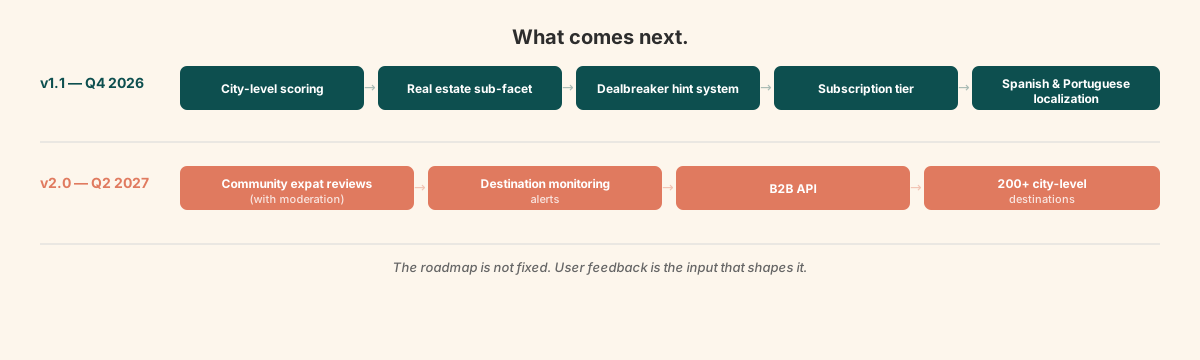
v1.1 targets Q4 2026. City-level scoring for the top 50 expat destinations. The dealbreaker system with score context labels and the hint engine. The real estate sub-facet with foreign ownership scoring and rental accessibility. A subscription tier. Spanish and Portuguese localization.
v2.0 targets Q2 2027. Community-contributed expat reviews with moderation. Destination monitoring alerts for subscribers. A B2B API for composite scores. 200+ city-level destinations.
If you are a user and something is missing from that list that would matter to your decision, I want to know about it. The roadmap is not fixed. User feedback is the input that shapes it.
The bigger argument
I want to close by saying something I believe and am willing to be wrong about.
The model I used to build WhereToAdvisor does not have a clean name yet. It is not vibe coding. It is not traditional product development. It is something in between: an experienced product leader who knows how to spec clearly, make ethical decisions early, and hold the line on principles when shortcuts present themselves, paired with AI as the implementation layer.
The products that get built this way will not all look like WhereToAdvisor. But I think the pattern will repeat, and I think it has implications for what product management becomes over the next several years.
The PM who can spec precisely and evaluate AI output critically will ship things that used to require a team. The PM who treats AI as a magic prompt-and-ship tool will build faster and produce something worse. The gap between those two outcomes is not technical skill. It is product thinking.
I spent years building products with teams. The thing I value from that experience is not knowing how to write code. It is knowing what good looks like, being able to describe it clearly enough that someone else can build it, and recognizing when what was built is not quite right even when it appears to be working.
AI is a very fast, very literal, very capable builder. It is not a product manager. The combination of the two is something I think we are only beginning to understand.
Six days. A live product. A real data pipeline. A scoring engine with genuine ethical constraints. A payment system. An architecture that took positions I am willing to defend.
That used to take months and a team. I do not think it will for much longer.
Thank you for following this series. The full six posts live at wheretoadvisor.com/blog. The product is at wheretoadvisor.com. If you relocated or are thinking about it, your feedback makes the next version better. If you build products, I would like to hear what questions this raised for you.